Showing posts with label Sarkul Wars. Show all posts

Thursday, 19 April 2012

A to Z: Q is for Quer'lharto

Quer'lharto Psion (Uhul)The Quer'lharto are a Minor Race descended from large nocturnal avianoid ground hunters. First encountered as prisoners of the Vargr of Suarya by Imperial Scout Antheas Golus in 832, the origins of the Quer'lharta remained obscure. The Vargr had acquired their prisoners from traders to Rimward as status symbols and exotica, but had little interest in where their homeworld was located.

Nearly a century after her first encounter with the Quer’lharto, Antheas Golus, having rescued and befriended the elderly Quer’lhar Ishrehk Rahkhar, finally located Klarekhek, the Quer’lhar birthworld.

She discovered a decaying technological society that had torn itself apart sometime in the mid 7th Century. Part of the population had left the planet, following a charismatic spiritual leader called Lherakhar Irrek. The Irrekites progression swiftly splinted after his death and his followers scattered, some eking out a living as mercenaries, others as labourers, but all apparently losing the wish or the will to return home.

Of those that remained behind on Klarekhek, most had abandoned their cities and returned to the countryside. Quer'lharta society, Antheas Golus discovered, had suffered an enormous trauma that had broken kin links and lineages. This trauma appeared to have its origins in the rise of a Psionic caste of leaders, both spiritual and political.

Golus’ studies were interrupted by the outbreak of the Sarkul Wars and the near-collapse of the RimWorlds Sector.

And somewhere out in the wilderness beyond the rim of the Imperium, the Quer’lharto are still trying to make sense of their society and why it collapsed.

Note: The figure pictured above is a Uhul, sculpted by Eli of I See Lead People and cast by 15mm.co.uk. I have modified it by giving it a Force Sword – an energy sword similar to a light sabre.

Sunday, 28 August 2011

Design Notes - Incremental Progression

Features of Gazolan SubsectorWith new figures to paint and a full diary, progressing development of Gazolan Subsector has temporarily stalled. I have, however, located the current (1109) subsector capital, Thiroor, at 2213.

Thiroor lies on the “lower lip” of the Wedding Cup, Miigaurshish and, incidentally, was one of the early systems in Gazolan Subsector to be occupied by the Imperium. House Hendrian of Thiroor, Subsector Dukes of Gazolan, have been slowly increasing their power and influence since the Sakul Wars of the late Ninth Century. With the death of Sector Duke Edenar in 1097, Akansair Hendrian was able to present both himself and his House as the most suitable candidate to succeed to the Sector Duchy. Akansair I was succeeded by his son Mekal in 1104. Mekal was succeeded by his brother, Akansair II, in 1107.

I need to re-examine the systems of the Wedding Cup as these would appear to be the core worlds of Gazolan Subsector – the centre of power that House Hendrian as protected and nurtured since the Sarkul Wars. It is these worlds that have given House Hendrian the wealth and resources to replace House Ulanor as Sector Dukes, and to hold their own against their enemies – both internal and external.

Tuesday, 23 November 2010

Design Notes

RimWorlds Sector map c. 1984
The series of basic overviews of the six developed subsectors of the RimWorlds, collectively known as “Accidents in Astrography”, has been a lot of fun for me to write. I have taken the opportunity of both revisiting these subsectors after many years, and gleaning information for my website – in particular Languages and Library Data – as well as creating some new material, such as some historical and Astrography details.

What is interesting is that I can still see the early development layers, and what Science Fiction was influencing me, as I wrote up the three original subsectors of Gamelea, Nolgor and Miazan. Gazul Subsector came next, but was only partially developed (and only one game was set there, from memory). Lymethius Subsector was developed to provide a little background for the Outrim Wars, and for a late period Esra Weinbach game – so named for the longest serving character in the RimWorlds - while Cabria Subsector was fleshed out to provide a bigger battleground in which to resist Imperial expansion. A recent, abortive, attempt to run a PBeM game resulted in me expanding the Hunt of Rronurl and Huiha Khysokhou.

One of things that enrich a campaign, in my opinion, is a deep background. Things on the surface happen for a reason; and the reason, or reasons, lie back in time. Like creating a character for a novel, a lot of this material will never see the light of day, but if the novelist or Referee has worked out this detail, he/she will know why things are happening that effect the Player Characters.

I’m a firm believer that a campaign needs both a chronology and a macro-map. The former can be just a series of bullet points collecting together significant events, or it can be an in-depth account of all events that have gone before, while the latter can just shows a high-altitude view of the campaign area, or a meticulous survey of the all regions surrounding the campaign area.

A chronology fixes the game in time, and gives reference points for the character – if the players know that the Imperium defeated the Kalar-Wi Empire in 1105, and they encounter a Kalar-Wi warship in the Border Worlds in 1109, it is possible that this ship is a relic of the war. The Kalar-Wi lost three systems to the Imperium in that war, as well as having their homeworld occupied. If the ship is wrecked it might have a treasure horde, looted from one of the worlds the Kalar-Wi lost, but if it is cruising, it could be an “unsurrendered” raider bent on revenge attacks. Likewise, a sector map showing subsector capitals allowed me to write up the likely course of the Sarkul Wars of 842 – 906 when I came to that section of the Imperial History of the RimWorlds. Up until that time, I had no idea what the Sarkul Wars were about; except that they were some form of civil war and that they disrupted the RimWorlds for sixty years. The character of Principle Secretary Lissa Sarkul only emerged as I began to write that section – and my love of Byzantine History allowed me to create the Byzantine levels of that conflict – where the clannish Subsector Dukes and Admirals actively resisted the centralising Sector Duke. The seeds of the war were planted two centuries prior to Lissa Sarkul, but her policies in the name of her Sector Duke revived the centrifugal nature of the original ‘gentleman-adventurer’ nature of settlement of the RimWorlds.

For my next series of articles on the RimWorlds, I’m going to look at the history of the region, and possibly do a little exploration into the Outrim Void to map the worlds I’ve hinted at in my accounts of Lymethius and Cabria subsectors.

Friday, 4 June 2010

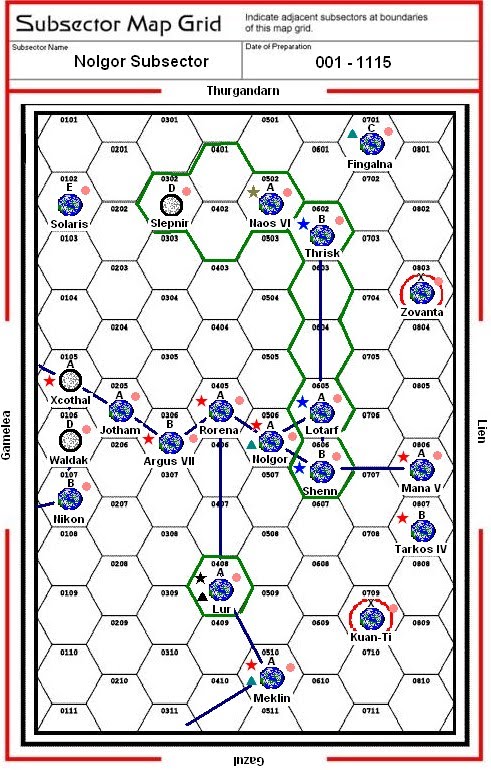
Accidents in Astrography: Nolgor Subsector #1

Nolgor Subsector
From Gilanda and Canblyne in Gamelea Subsector, the Nolgor Run crosses Nolgor Subsector from Xcothal to Shenn and Lotarf, skirting the Rimward edge of the J-3, or Canblyne, Rift. Astrographically, Nolgor Subsector is fragmented and resource-poor. The Nolgor Run, which should have become a major trade route enhancing the economic development of the subsector, has instead become a dismal tour of a series of Non-Industrial and Agricultural worlds with moribund economies.

After serving as a forward base during the Rimward Wars of the late 7th Century, Nolgor Subsector stagnated as the colonies further rimward in the Imperial-controlled Coreward half of Gazul Subsector developed and prospered. Home to a native Minor Race, a transplanted Minor Race, a regressed human colony, and an Imperial Prison Planet, Nolgor Subsector has never lost that feeling of being a wild frontier. This is in spite of being surrounded by more economically successful, and politically stable, Imperial subsectors.

The crustacean-like Zoni Minor Race of Lur proved incredibly difficult for the Imperial authorities in Nolgor Subsector to deal with. Alternatively neutral and hostile, the Zoni consumed a disproportionate amount of subsector resources in containment and pacification efforts, none of which proved effective in the long run. Even Admiral Kranan hault-Lernester’s famous ‘Pounding of Lur’, during his ‘March to the Rimward Border’ campaign in the early part of the Sarkul Wars, only bought a century of respite from Zoni raids. And this was after hault-Lernester had systematically destroyed every single shipyard and ship repair facility in the Lur system, and then bombed every heavy industrial site on the planet. This on-going commitment to contain the Zoni became a serious drain on the economies of the Imperial planets of the subsector, hampering efforts to stimulate trade and technological development, while political mismanagement heightened resentment at the planetary level.

The saurianoid Tsalur of Xcothal acknowledge that they are not natives of the world they currently call their own, and that they have lost all records of where their homeworld might be. They appear to have been settled on Xcothal by the Thongaloras Empire over a thousand years ago and survived the fall of that empire as well as the subsequent turbulent centuries prior to the arrival of the Imperium in the RimWorlds in the early 6th Century. With a fierce warrior culture, the Tsalur respect strong leadership and will willingly follow even non-Tsalur if they demonstrate this quality. This has lead some xeno-anthropologists to theorise that the Tsalur were culturally manipulated to fill some form of slave-warrior niche within Thongaloras society, and that this imprinting still survives some 900 years after the imprinting society vanished from the Galactic stage.

Little is known of the Shenni of Shenn apart from the fact that they are humanoid and have a fighting caste that wears chitin-like armour and serve the Theocrats of Lotarf with fanatical loyalty. Within the last decade or so it has become apparent that the Shenni are actually a Zoni Hive that established itself on Shenn nearly a thousand years ago, and who were subverted by early members of the Order of Saint Belesarn of Lotarf some four hundred years later.

Fingalna is the homeworld of the Visi, a regressed Human colony. Sometimes known as the Aulteltec, the Visi seem to have appeared in the RimWorlds during the Late Thongaloras Empire, perhaps aboard Long Night period sublight ships. On the dozen or so planets where Aulteltec settlements have been identified, they are characterised by the existence of massive stone step pyramid structures in the centre of settlement areas. Fingalna is the only known planet where Aulteltec culture has survived as a living entity.

Political fragmentation during the 11th Century caused the Voivodate of Naos VI and its colony of Slepnir to refuse to acknowledge the subsector leadership of the House Ulanor Dukes of Nolgor. At a stroke, nine and a half billion sophonts and the subsector’s only industrial world were removed from the moribund economy, plunging the subsector into economic depression. When the Theocracy of Lotarf, with its daughter worlds of Shenn and Thrisk, followed suit, only 135 million sophonts on 13 worlds still remained Imperial citizens, under one and a half percent of the subsector’s population of 9.8 billion.