Tuesday, 22 June 2010

Website Update #6

Khurasan Miniatures Orca Assault Troops - work in progressReceived a figure order from Khurasan Miniatures yesterday and spent a very pleasant afternoon assembling Sea Wasp grav vehicles and Orca Assault Troopers.

Great figures and good service, check them out for unusual aliens and interesting vehicles. Full details of the order and what I received are on the Modeling and Painting log page of my website.

Monday, 14 June 2010

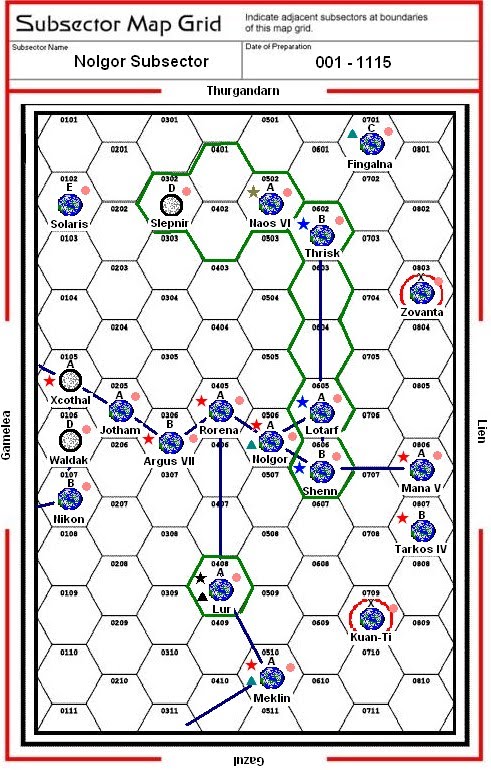
Accidents in Astrography: Nolgor Subsector #2

Nolgor SubsectorCursed with a Ducal House with lofty ambitions and insufficient resources, Nolgor Subsector has often seen its armed forces drawn away, either in pursuit of, or in support of, the Sector Ducal crown. This constant drain has contributed to the inability of the Subsector authorities to maintain control over the worlds within the Subsector. Of the twelve Naval bases in the Subsector, seven remain under Imperial control. The loss of the huge Tech Level 12 shipyards of Naos VI reduced the Subsector Navy’s ability to recover from losses quickly. The next largest yards, at Nolgor, are only Tech Level 11 and have only 1% of the capacity of the yards at Naos VI. Imperial Naval units assigned to Nolgor have to be serviced at Gamelea, as this is the nearest Tech Level 15 facility, and once sent out of theatre for servicing often don’t come back again as they’re promptly reassigned along the Outrim frontier or sent into Miazan Subsector.

Nolgor Subsector consists of 20 systems. Weak and divided, only 14 systems are under Imperial control. The Hegemony of Lotarf, controlling Lotarf, Shenn and Thrisk; the Zoni of Lur; and the Voivodate of Naos VI, controlling Naos VI and Sleipner, effectively divide the subsector in two. With a total subsector population of 9.87 billion sophonts (9.8*10^9), of which less than 0.5% are non-Human, 135.5 million are Imperial citizens, 156.2 million are subjects of the Hegemony of Lotarf, 34.5 million are estimated to inhabit Lur, and 9.5 billion dwell within the borders of the Voivodate of Naos VI.

The highest Tech Level in the subsector, Tech Level E (14), is at Meklin, while the most densely populated planet is Naos VI. Lotarf, with a population of 107 million, is the next most populous planet. Zovanta and Kuan-Ti are Red Zones, Zovanta on account of its primitive inhabitants and Kuan-Ti as it has been incompletely explored. Tarkos IV is an Imperial Prison Planet.

There are three main dialects of Imperial Basic spoken in the Nolgor Subsector:
1) Nolgor Imperial Basic: - spoken along the Nolgor Run to Trailing of Gamelea Subsector.
2) Spinward Gazuli Basic: Dialect of Gazuli Basic as spoken along the Dokarian Main in Gazul Subsector, and on Meklin in Nolgor Subsector.
3) Thurgandarni Basic: Dialect of Imperial Basic common in the Thurgandarn Subsector, Coreward of Nolgor Subsector, and spoken on Solaris, Slepnir and Naos VI.

Other minor languages include Tsalui, the native language of the Tsalur Minor Race of Xcothal; Zyaos, the native language of the Zoni Minor Race of Lur; Algrath, the native language of the Shenni Minor Race of Shenn; Veultaqual, language of the regressed human Visi people of Fingalna.

Saturday, 12 June 2010

Aslan

Cover of 'Alien Module 1: Aslan' by Gareth Hanrahan - Mongoose Publishing

Alien Module 1: Aslan
by Gareth Hanrahan


“You know, I like cats -- and lesbians -- but I really hate the Aslan more with each new reincarnation of the Trav setting/rules. Their whole Cat People of Mongo (Wherein It Rains) thing is one detraction, but what really puts me off is this whole cod-samurai shtick that's been accreting over years. All this freakin' "honor!" yelping - it's like some horrible Tekumel session staged with stuffed animals swiped from a Disney gift shop.”
- The ‘Sayat Menace’ on the Traveller Mailing List

I’ve never met the ‘Sayat Menace’, but I enjoyed his thoughts on the Aslan as quoted above – completely without permission – from a post on the Traveller Mailing List. This was prior to the publication of Alien Module 1: Aslan by Mongoose Publishing as part of their ‘The Third Imperium’ Traveller line.

Of the Classic Traveller Major Races, I’ve always liked both the Aslan and the Vargr as they appeal to different aspects of my own personality – the Vargr as anarchic, rough and tumble, go from here to there via all the nooks, crannies and byways types and the Aslan as calm, controlled, honest, honourable and upright. I enjoyed the Classic Traveller Alien Module 1: Aslan and so was Cover of Classic Traveller Alien Module 1: Aslan by J. Andrew Keith, John Harshman and Marc W. Millerrather intrigued to see what Mongoose would make of the information about the Aslan that has accumulated over the last couple of decades.

At 228 pages, Mongoose’s effort is no light-weight, and offers Aslan-orientated Character Generation (including clan, pride and family and the Rite of Passage; extensive notes on the Aslan Race (including Aslan Society, the importance of land to male Aslan, duelling and honour); Aslan History; typical equipment; starships (including stats and deckplans for a variety of ship types); encounters – Patrons, NPCs and animal encounters; Aslan World generation; and notes on roleplaying Aslan.

70-odd pages of this module provide a fairly good over-view of the Trojan Reach Sector, largely drawn from the work of Mike Jackson in the Third Imperium fanzine, as a backdrop for adventures featuring Aslan. Trojan Reach lies Rimward of the Spinward March and includes Aslan states both large and small, the Florian humanoid/Human Minor Race, Imperial worlds, Imperial Client States and independent worlds and polities.

Even if you do have access to the Classic Traveller Alien Module 1: Aslan – reprints are available from Far Future Enterprises – this new work is still worth getting, in my opinion. I particularly like the notes on both roleplaying Aslan, and GMing Aslan in a campaign where the author has, in fact, set out to offer alternatives to the “cod-samurai shtick” bemoaned of by The Sayat Menace.

Points where I think further work could have been done are in the section on Trokh, the Aslan language; in some of the artwork used within the book; and in the editing of the Trojan Reach material.

In the latter case, the text meanders between the use of the term ‘subsector’ and ‘sector’ to describe the individual subsectors of the Trojan Reach sector. To me, this feels more akin to the fanzine material of the 1980’s when such terms were still becoming fixed, rather than current useage.

Book artwork is always a subjective thing - you either like the pictures or you don't - but considering that Aslan have a natural blade weapon in their dewclaw, and it is stated in the text that blade weapon skills are fairly rare amongst Aslan, I began to get annoyed at the number of illustrations showing sword-weilding Aslan.

In the case of Trokh, while letter frequencies, syllable construction and pronunciation are discussed; the word generation tables of the Classic Traveller module are not reprinted. I do not know if this is an IP issue or not, though with the sound frequency table it is possible to make your own. Nowadays, I tend to generate my Trokh words using Space Corsair’s excellent word generator anyway, but it would have been nice to see those old tables again.

So, minor quibbles aside, another good book for Traveller.

Monday, 7 June 2010

Issue 2 of 'Into the Deep' fanzine released

Cover of Issue 2 of 'Into the Deep' - June 2010
Issue 2 of this Classic Traveller orientated webzine has just been released. Available for the bargain price of free from here, it is well worth a look. You will have to join the Yahoo group, but fifty other people appear to have managed that task roll so it shouldn't be much of a chore.

I should mention that a revised and expanded version of my blog post on 'Nobles' does appear in this issue of 'Into the Deep' but the magazine is still a good read, anyway.

Friday, 4 June 2010

Accidents in Astrography: Nolgor Subsector #1

Nolgor Subsector
From Gilanda and Canblyne in Gamelea Subsector, the Nolgor Run crosses Nolgor Subsector from Xcothal to Shenn and Lotarf, skirting the Rimward edge of the J-3, or Canblyne, Rift. Astrographically, Nolgor Subsector is fragmented and resource-poor. The Nolgor Run, which should have become a major trade route enhancing the economic development of the subsector, has instead become a dismal tour of a series of Non-Industrial and Agricultural worlds with moribund economies.

After serving as a forward base during the Rimward Wars of the late 7th Century, Nolgor Subsector stagnated as the colonies further rimward in the Imperial-controlled Coreward half of Gazul Subsector developed and prospered. Home to a native Minor Race, a transplanted Minor Race, a regressed human colony, and an Imperial Prison Planet, Nolgor Subsector has never lost that feeling of being a wild frontier. This is in spite of being surrounded by more economically successful, and politically stable, Imperial subsectors.

The crustacean-like Zoni Minor Race of Lur proved incredibly difficult for the Imperial authorities in Nolgor Subsector to deal with. Alternatively neutral and hostile, the Zoni consumed a disproportionate amount of subsector resources in containment and pacification efforts, none of which proved effective in the long run. Even Admiral Kranan hault-Lernester’s famous ‘Pounding of Lur’, during his ‘March to the Rimward Border’ campaign in the early part of the Sarkul Wars, only bought a century of respite from Zoni raids. And this was after hault-Lernester had systematically destroyed every single shipyard and ship repair facility in the Lur system, and then bombed every heavy industrial site on the planet. This on-going commitment to contain the Zoni became a serious drain on the economies of the Imperial planets of the subsector, hampering efforts to stimulate trade and technological development, while political mismanagement heightened resentment at the planetary level.

The saurianoid Tsalur of Xcothal acknowledge that they are not natives of the world they currently call their own, and that they have lost all records of where their homeworld might be. They appear to have been settled on Xcothal by the Thongaloras Empire over a thousand years ago and survived the fall of that empire as well as the subsequent turbulent centuries prior to the arrival of the Imperium in the RimWorlds in the early 6th Century. With a fierce warrior culture, the Tsalur respect strong leadership and will willingly follow even non-Tsalur if they demonstrate this quality. This has lead some xeno-anthropologists to theorise that the Tsalur were culturally manipulated to fill some form of slave-warrior niche within Thongaloras society, and that this imprinting still survives some 900 years after the imprinting society vanished from the Galactic stage.

Little is known of the Shenni of Shenn apart from the fact that they are humanoid and have a fighting caste that wears chitin-like armour and serve the Theocrats of Lotarf with fanatical loyalty. Within the last decade or so it has become apparent that the Shenni are actually a Zoni Hive that established itself on Shenn nearly a thousand years ago, and who were subverted by early members of the Order of Saint Belesarn of Lotarf some four hundred years later.

Fingalna is the homeworld of the Visi, a regressed Human colony. Sometimes known as the Aulteltec, the Visi seem to have appeared in the RimWorlds during the Late Thongaloras Empire, perhaps aboard Long Night period sublight ships. On the dozen or so planets where Aulteltec settlements have been identified, they are characterised by the existence of massive stone step pyramid structures in the centre of settlement areas. Fingalna is the only known planet where Aulteltec culture has survived as a living entity.

Political fragmentation during the 11th Century caused the Voivodate of Naos VI and its colony of Slepnir to refuse to acknowledge the subsector leadership of the House Ulanor Dukes of Nolgor. At a stroke, nine and a half billion sophonts and the subsector’s only industrial world were removed from the moribund economy, plunging the subsector into economic depression. When the Theocracy of Lotarf, with its daughter worlds of Shenn and Thrisk, followed suit, only 135 million sophonts on 13 worlds still remained Imperial citizens, under one and a half percent of the subsector’s population of 9.8 billion.

Friday, 21 May 2010

Humaniti

Cover of GURPs Traveller: Humaniti by Loren K. Wiseman and Jon F. Zeigler

GURPs Traveller: Humaniti
Compiled and Edited by Loren Wiseman and Jon F. Zeigler


A lot of Traveller people don’t like GURPs as a roleplaying system and, consequently, never considered GURPs Traveller for their Traveller needs in the dark years between the fall of GDW, when the oceans drank Atlantis, and the rise of the Geese of Mong. Funny thing is though, a lot of other people love GURPs and play GURPs Traveller, as is evident by the very active GURPs Traveller board that Steve Jackson Games hosts. Interstellar Wars, the first GURPs Traveller product for GURPs 4e, did not, apparently, sell as well as was hoped and this has, sadly, rather put the kibosh on further Traveller products, but SJG still keeps much of their existing Traveller product line in print. GURPs Traveller: Humaniti is one such item and I was fortunate enough to pick it up a year or so ago from SJG’s excellent Warehouse 23.

For the Traveller fan, sixteen Human Minor Races are presented in Humaniti in sufficient detail to make for interesting, and alien additions to a Traveller campaign. Most of these Minor Races have appeared in earlier Traveller publications, such as the original Journal of the Travellers’ Aid Society or Challenge magazine, but this is the first time that they have been brought together in one place and examined in detail.

The origins and history of each race are presented, along with their physiology and appearance. Languages; naming conventions; society and government; and technology and trade are all considered, and maps of the homeworlds of several of the races are included. Finally, each race is presented as a template for GURPs Traveller character generation, which is fairly easy to convert to other versions of Traveller with a little thought and some common sense. It should be stressed that this is a very rules-lite Traveller supplement and its value lies chiefly in its text.

I am very satisfied with GURPs Traveller: Humaniti and look forward to being able to introduce some of these Minor Races into my campaign.

Sunday, 2 May 2010

Accidents in Astrogation: Gamelea Subsector #3

Gamelea Subsector
Gamelea Subsector consists of 17 systems, 16 of which are part of the Duchy of Gamelea and under Imperial control. The 17th system, Kalar-Wi, while nominally under Imperial occupation, is in the process of being returned to local rule under the terms of the treaty that concluded the Kalar-Wi War of 1103 – 1105.

The subsector has a population of 142.7 billion (1.427 x 10^11) sophonts of which 99% are human, or of human descent. The three minor races native to the subsector; the Kalar-Wi, the Rimbaur of Rimbaud II, and the Julnari of Julnar, only number some 92.3 million, of which 91 million are Kalar-Wi.

The most densely populated world in the subsector is Bryak with a population of 99.9 billion. The next most populous world is Gamelea, the subsector capital, with a population of 29.3 billion. The highest tech systems are Gamelea and Julnar with a Tech Level of 15 (F). Syndon IV is a Red Zone and an Imperial reservation. Interdiction satellites, deployed to protect the Tech Level 2 native culture, orbit the planet. The Kerak system was abandoned in the 1080’s, and its main starport mothballed, when the marginal mineral deposits paid out. This retrenchment caused the fragile economy of neighbouring Tulvan to slide into a three-decade long recession.

There are two main language groups within the Gamelea Subsector, Vriok - the main Kalar-Wi language spoken on Kalar-Wi and the worlds of the old Kalar-Wi Empire, such as Varch, Anthorann and Rimbaud II – and Imperial Basic – the standard language form of the third Imperium. Imperial Basic is further divided into regional dialects that are drifting apart through the natural evolution of living languages.

There are three main dialects of Imperial Basic:
1) Gamelea Imperial Basic: - spoken in the Gamelea Cluster (Kalath, Feor, Vanvlack VII, Gamelea and Ventura), and on Varch, Anthorann, Rimbaud II and Bryak. Both Anthorann and Bryak have strong local accents and the Anthorannis have picked up a lot of Vriok loan words after some 70 years of Kalar-Wi rule.
2) Cassingal: - a dialect of Gazolin Imperial Basic, Cassingal has spread over the coreward border of the Gamelea Subsector and is spoken on all the worlds of the Julnar Reach. Gamelea Imperial Basic speakers and Cassingal speakers can understand each other, though quietly laugh at each other’s accents and spelling conventions.
3) Nolgor Imperial Basic: - spoken on Canblyne and Gilanda and indicative of these two worlds cultural links to the populations of the Nolgor Run to Trailing of Gamelea Subsector.

Other minor languages include Kalton, the native language of the Rimbaur Minor Race of Rimbaud II; Arkord, the native language of the primitive humanoid Arkordi of Syndon IV; and Oloro, the native language of the amphibian Julnari of Julnar.