Friday, 13 April 2012

A to Z: L is for Language and Leviathan

Trokh random word generator from Alien Module 1: AslanLanguage
Way back when I did my “I for Imperial Basic” post, I had good intentions of expanding upon the languages in Traveller theme by doing an “L for Languages” post. This is because back in April 2010 I posted a simple system for working out what languages a character might possibly know. Not having really had the opportunity to revisit the system, it still seems to me to provide a reasonably neat way of handling languages within the context of the game. I would appreciate feedback or playtest reports if anyone would like to give them a go.

Leviathan
I first encountered the term “Land Leviathan” as the title to a novel by Michael Morcock – one of his Oswald Bastable science fantasies set in an alternative early 1900s – 1930s Earth. Somewhere about the same time, or a little earlier, I saw Star Wars and caught glimpses of the massive and enigmatic Jawa Sandcrawler.

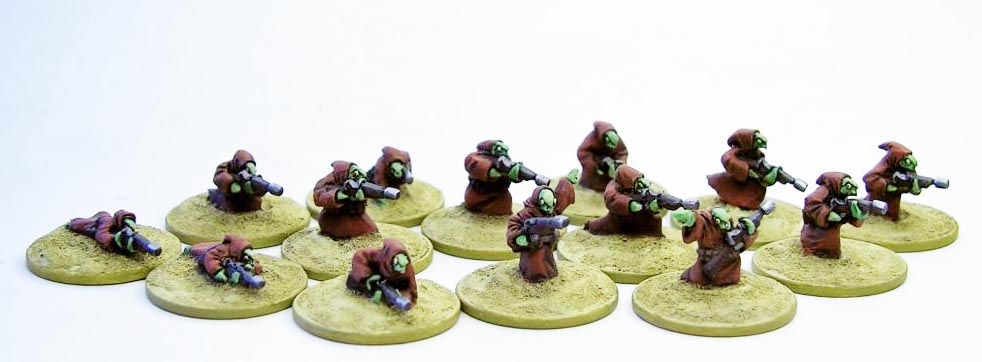
In the late 1970's, New Zealand wasn't the end of the Earth – but you could certainly see it from here. So we missed out on most of the really cool Star Wars toys that people now pay fortunes for on eBay. Consequently, I wasn't even aware that model Sandcrawlers existed until very recently when I was looking for a ride for my newly-painted Chewks.

Produced by Khurasan Miniatures, the Chewks are a desert-dwelling, crustacean-like species who actually look nothing like Jawas, but who tick the Jawa-box for me. I've decided to incorporate them into my Traveller campaign as proxies for the Ly-ly, natives of Gyven’s World, a desert planet in the Cabria Subsector.

Looking for a vehicle that ticked the Sandcrawler box, I eventually settled on a 1/72nd scale A7V – a German tank from World War I that looks like an iron box on tracks. As my miniatures are all 15mm, or 1/100th scale, a large vehicle in 1/72nd scale looks even more massive, especially as being unfamiliar to most people, it's hard to establish a visual scale.

While I was looking around for vehicles, I came across this monster (below): the LVTP-5, an armoured landing craft used by the US Marines in Vietnam. While the more modern AAV-7 looks vaguely boat-like, the designers of the LVTP-5 must have decided that “put a large enough engine in a floating metal box and it will eventually move in the direction you want it to.”

I ended up buying a 15mm scale model from Peter Pig and then painted it up in a random camo pattern. The vehicle “unit number” is from a font called “Angled” and was hand drawn in pencil, inked with a felt-tipped pen, and then hand-painted.

A UNSC Marine from Ground Zero Games and a Chewk from Khurasan Miniatures are there to give a sense of scale to the vehicle.
I could not work out which was the front end of the LVTP-5 until I saw a photo of one actually at sea – the domed hatches belong to the driver and commander while what I thought was a boxy bridge is actually a command cupola for the marines riding as passengers.

The A7V is still awaiting assembly.

One of the best Traveller adventures from amongst Games Designers' Workshop's stable of adventure modules is Adventure 4: Leviathan. The characters play crucial crew members aboard the 1800 ton Jump-3 merchant ship, Leviathan, on a trade and exploration mission beyond the borders of the Imperium. Essentially a road trip, the characters know that there are systems out there in the wilderness, and their job is to go out, make first contact, and trade beads and axe heads (or the Traveller equivalent thereof) for lucrative and exotic stuff they can bring back home.

Thinking about this adventure module today, I was, once again, reminded of the great wonder of the unknown we felt; even playing adventures set in the Official Traveller Universe, back in those days. At that time, Supplement3: The Spinward March had given us a look at one Sector of the Imperium, and a large scale map of the Imperium, much like the wide view on this website, was doing the rounds as a promotional piece of art. Beyond that, the galaxy and the Universe belonged to the Traveller players, and their Games Masters.

Then along came this adventure script and this invitation to leave familiar space ... . Traveller has this Age-of-Sail vibe due to its travel times and its communication limitations and the Leviathan adventure invited you, as the player, to step aboard with Columbus, de Gama, d’Urville and Cook and boldly sail beyond the edge of the map into the bits of space marked, “here be dragons”.

Have we lost this wonder? I follow an astronomy blog called Centauri Dreams and try to keep up to date with developments in astronomy – part of satisfying the science that goes with the fiction – and astronomers are now detecting exoplanets only a few orders of magnitude larger than our Earth. By the time we have developed a Jump Drive, we may very well be able to detect the glow of alien cities in the night sky of any planet we care to visit. Would Columbus have sailed to the new world if he had known that he would be stuck in traffic in the Antillian equivalent of the Seville rush hour? Likewise in Traveller, the massive mapping-of-the-known-universe project, started by DPG, and continued by the fan group HIWG, essentially filled in all the lovely vague bits on the Traveller Imperium map – because we have this incessant need to know what’s over “there” – until the only way to “refresh” the official Traveller universe, was to destroy it.

So, that’s my old grognard’s lament – the surveyors taking all the magic out of the unknown – and the reason why I have left large sections of my sector map only vaguely mapped. Like Leviathan - the original one - mystery and the thrill of the unknown need unfathomed deeps to lurk in. Micromanagement shines light in all the cracks and crevices and kills wonder. Sometimes, it is better to leave blank bits on the map, so when the players suddenly set off in that direction, the Games Master goes along as an explorer, too. Sharing the excitement of exploring something new should be a thrill for both the narrator and the participants.

Wednesday, 11 April 2012

A to Z: K is for Kamperel

Kamperel is a system in My Traveller Universe, the RimWorlds Sector. Kamperel and the Kamperelian Republic are one of those little quirks that get thrown up by random system generation, and then take on a life of their own when a little thought is applied.

The Kamperelian Republic is a three-system polity near the centre of Miazan Subsector, consisting of the systems of Kamperal, Floranna and Ektra. Once member worlds of the Imperium, Kamperel and its two subject systems now refuse to recognise the authority of either the Subsector Duke of Miazan, or the Sector Duke. As the population of Kamperel numbers a large percentage of the total population of the Subsector, the House Geyukthi Subsector Dukes of Miazan have not been able to muster the resources to bring Kamperel to heel.

So, how did this situation come about?

Kamperel, Floranna and Ektra make up the Kamperel Cluster – a group of stars within one parsec of each other and separated by at least two parsecs from all neighbouring systems. This makes their location fairly strategic because all trade moving through the subsector is either obliged to move through Kamperelian space, or divert around it, adding many weeks to transit times.

Kamperel is a small, poor, dry world with a very thin atmosphere, a population in the 10s of billions, and a Tech Level of 11 – low interstellar. Ektra is a small, desert world with a very thin tainted atmosphere, a population in the low millions and a Tech Level of 8. Floranna is an average-sized water world with a standard, tainted atmosphere, a population in the millions and a Tech Level of 12. One thing all three systems share is that their populations live in sealed environments. Otherwise, there was not a lot to distinguish them from any number of other systems.

In my notes on the history of the RimWorlds, there was a mysterious entry, “1032 Cessation of the Rivokul War”. What I had originally intended by that entry, I no longer remember. During late 2007/early 2008, as I was creating my Traveller website and working up the Library Data, I decided upon this:
“House Rivokul, as retainers of the Geyukthi Dukes of Miazan Subsector, had been Siridar-Barons of Kamperel/Miazan since the middle of the 10th Century. Outrageously corrupt, they had mercilessly exploited the huge population of their small, poor world. While the 3rd Outrim War was at its height, clandestine shipments of arms from the Outrim Alliance began reaching the People’s Justice Army of Kamperel. For eighteen months in 1031 – 32 the People’s Justice Army took on House Rivokul’s brutal mercenary guardsmen, fighting for control of the factories and tower blocks of Kamperel. A young Torvor Van Zaquerl, barely nineteen years old, personally led a team that penetrated House Rivokul’s fortress-palace where the entire family, and their retainers, were summarily executed.

"By the time Sector Duke Yuri Sehlemarl had concluded the 3rd Outrim War in 1038, a republican government headed by Torvor Van Zaquerl was firmly established on Kamperel. As most of House Geyukthi, who had supported House Rivokul, or at least turned a blind eye to their misdeeds, had perished in the Outrim War, there was little political will to overturn the new administration on Kamperel, provided it remained loyal to the Imperium and its appointed representative, the Sector Duke.”

So, a throw-away line in a note book had become a fully fledged event, with personalities and links to outside events.

During the 3rd Outrim War, Outrim Alliance raiders penetrated through much of Miazan Subsector. As Alliance ground forces were faring poorly against Imperial garrisons – lacking both the numbers and the technology to take planets with any decent-sized population – Alliance Command switched to the alternate tactic of arming and encouraging local resistance and revolutionary movements in an effort to force Imperial Forces to spread out to protect their hinterland. House Rivokul, already corrupt and hated by their subjects, was a prime contender for this tactic.

The Kamperelian Republic remained quiescent after the Outrim War, while extending their economic domination over their near neighbour, Ektra. In 1051, the Ektrans turned on the Kamperelian Merchant Factors on-planet and sacked their compounds. Torvor Van Zaquerl, now “Governor” of Kamperal, dispatched six Kamperelian Cruisers and an invasion force against Ektra. After a savage bombardment, the Ektrans surrendered to Kamperel and have been garrisoned ever since.

Kamperel remained neutral during the 4th Outrim War of 1080 – 85, but one of Marc Van Zaquerl’s first acts as Governor, upon succeeded his father Torvor in 1082, was to launch a sudden attack on Floranna. Under the guise of securing the Kamperel Cluster against Outrim raiders, Van Zaquerl’s task force caught the Florannese SDB flotilla unprepared and destroyed them. The sub aquatic domed cities of Floranna held out against the Kamperelians for another twenty months, but were eventually forced to surrender.

In the aftermath of the Outrim War, Imperial authorities in Miazan Subsector were, once again, in such a weakened state that apart from lodging a protest with the Sector Ducal Court they, once more, acquiesced with the fait accompli they had been presented with.

In the subsequent 30 years, relations between the Subsector Duchy and the Kamperelians have been cool.

One interesting effect of the topography that the Kamperelian armed forces operate in is that they are one of the few militaries to have developed walker technology beyond humanoid droids. Wheeled traffic has never really developed on any of the three main worlds of the Cluster. Both the sub aquatic cities of Floranna and the warrens of Ektra are effectively closed-in tunnel environments, very similar to the megacity sprawl of Kamperel’s inhabited zone in that they are three-dimensional mazes designed for human access only. Vehicular transportation for the Kamperelian military is limited to Power Armour or Walkers as these can cope with the narrow access halls, staircases and lift shafts.

A to Z: J is for Jump Drive

Making the Jump to Jump SpaceIn Science Fiction, there is usually a need to be able to get from star system to star system in a reasonable amount of time. There are a few writers who enjoy telling a really scientifically staunch story that has the characters travelling between the stars at relativistic speeds in light-huggers (Alastair Reynolds’ “Revelation Space” series and Larry Niven’s “Protector” spring to mind, and though Gary Gibson’s “Stealing Light” novel has a future human species adhering to Einsteinian Space/Time, he gets around it by having the humans’ sub-light ships hitch rides aboard alien craft which can go faster than light), most writers opt for the macguffin of some form of Faster-than-Light stardrive – see the entertaining “Atomic Rocket” website for articles on the subject.

In Traveller, there are a few rules but no detail. The rules are:
• A Jump takes one week, no matter the distance covered.

• The starship and its passengers are completely isolated from both other ships and people in Jump Space, and from other ships and people in Real Space.

• A starship cannot enter Jump Space within 100 diameters of a planet or a star.

• A starship in Jump Space passing within 100 diameters of a planet or star will be precipitated out of Jump Space into Real Space.

While we have few other concrete details, we can, of course, speculate:

A starship cannot enter Jump Space within 100 diameters of a planet or a star and a starship in Jump Space passing within 100 diameters of a planet or star will be precipitated out of Jump Space into Real Space.
The implication of this is that gravity wells and mass points interfere with both the transition from Real Space to Jump Space, and travel within Jump Space. This reminds me a lot of CJ Cherryh’s novel, “Tri-planetary”, and the triple mass-point of the title which allows starships to drop back into Real Space to both correct course and indulge in illicit trade.

I think it’s in GURPs: Traveller that we first see the idea of Jump Masking. This is where the relationship between the destination Main World and its stellar Primary become important when plotting Jumps. In part, this seems like a game mechanic to force player characters and their ships to spend a little more time in Real Space where they might fall prey to pirates or raiders (and so create tense and exciting game sessions), and in part this seems to be a logical extension of the 100 diameter rule. For instance, our sun – a standard G Class star - has a diameter of about 1.4 million kilometres. This means that a ship has to be at least 140 million kilometres from our sun to Jump, or to exit Jump. As Earth orbits our sun at a mean 149 million kilometres, then ships with line of sight to Earth would, in theory, only have to worry about Earth’s 100 diameter zone.

Though, even if the Main World is outside the 100 diameter limit of the primary star, there will be times of the year when the Primary will be between the Main World and the world any incoming ship is jumping from. In that case, it is likely that there will be an inbound Jump Zone at, say, the destination system zenith and an outbound Jump Zone at the system nadir.

The starship and its passengers are completely isolated from both other ships and people in Jump Space, and from other ships and people in Real Space.
This is one of the distinctive features of Traveller Jump Space in that once the ship has Jumped, it is pretty much self contained within its Jump Bubble. The Jump Bubble extends some little way beyond the exterior surface of the ship so that it is, in theory, possible for other matter to travel along with the ship. CJ Cherryh’s Chanur novels are, to me, the most evocative of Traveller-esque fiction written by someone who has probably never heard of Traveller. In one of the novels, the characters Jump while passing through a dust/gravel cloud near an asteroid belt. When they drop out of Jump Space, there is consternation from local System Traffic control as they release a cloud of near-light speed gravel from their Jump field and send it sleeting across the destination system.

A Jump takes one week, no matter the distance covered.
This is the biggy and one of the constants of Traveller. Jump Drives are rated by the distance, in parsecs, they can move a ship in a single Jump. A Jump takes one week and can range from one to six parsecs. But, how does it work?

We are told that as the Jump Drive activates, it creates a bubble (the Jump Bubble) around the ship. Simultaneously, it tears a hole in three-dimensional space and draws the Jump Bubble into Jump Space. The hole seals behind the departing ship and, to an observer, the ship vanishes. A week later, the Jump Drive tears a second hole in three-dimensional space and expels the Jump Bubble into Real Space. The Jump Bubble collapses during this process and the release of energy creates what is known as a Jump Flash. This Flash is detectable out to several million kilometres so if one wishes to come and go quietly, one needs to drop down out of Jump Space way out in the Kuiper Belt or the Oort Cloud, away from the Zenith and Nadir Jump Zones, and come insystem on a very low deltaV approach.

I postulated a theory that Jump Drives actually access higher energy states. The topography of these energy states directly maps over the topography of Real Space, but each higher energy state is smaller than the next lower. This curves space.

Gravity is a constant, and as such gravity wells created by stars, planets and planetoidal masses penetrate through the stacked energy states. This means that mass points will interrupt travel through higher energy states and precipitate the starship back into Real Space.

As each higher energy state is smaller than the one below it, distances between points are shorter and so travel for the same amount of time will take one further at a higher energy state than at a lower energy state. On the other hand, it takes more fuel to attain the higher energy state which is why a Jump-6 ship needs to have 60% of its mass as fuel, when a Jump-1 ship only requires 10% of its mass as fuel.

Jump Flash is partially caused by the drop down of the starship into normal space, and partially by the leakage of energy from the higher energy states into Real Space.

It is believed that Human-built Jump Drives are not very efficient as Droyne ships do not give off Jump Flashes when they drop down into Real Space. Which makes one wonder what the Droyne know of Jump Space and higher energy states that Humans are yet to discover.

Tuesday, 10 April 2012

A to Z: I is for Imperial Basic

LanguagesIn My Traveller Universe, Imperial Basic is the main written and spoken language of the 3rd Imperium, derived from Solomani Basic (also known as Galanglic) with Vilani loan words and grammatical borrowings. Due to the vast size of the Imperium, and the relative slowness of communications, Imperial Basic has evolved several distinct regional dialects and accents.

Within my Traveller Universe, the RimWorlds Sector, most subsector populations have a distinctive accent and form of Imperial basic, though these dialectal groupings may spill across subsector borders along stellar mains or through clusters.

While transfers of popular media through trade might tend to act as a unifying agent when it comes population language accents, such transfers are unlikely to take lasting root amongst populations numbering into the billions. The effect would be akin to, say, fans of London gangster movies adopting a faux-East-Ender accent amongst themselves, but reverting to their native New Zealand twang when communicating with people outside their social interest group.

Playing around with dialects and languages can add an extra dimension to your players’ immersion in your Traveller campaign – reminding them that, in their imaginations, they are a long, long way away from home.

Monday, 9 April 2012

A to Z: H is for House

House and Palace of MysoreIn My Traveller Universe (IMTU) the families of the Nobility are divided into two classes – Houses Major and Houses Minor.

Houses Major make up the Imperial Nobility. It is from their ranks that the system, Subsector and Sector rulers are drawn. Houses Minor make up the planetary nobility, the industrial nobility and the upper echelons of the bureaucracy.

In Traveller, it is the Social Status characteristic that determines whether a character is “of the nobility”, or has been ennobled as a reward for meritorious service. A Social Status of 11 indicates that the character has been knighted. The Emperor or one of the Archdukes of the Imperium may bestow an Imperial Knighthood upon a character – such an honour usually includes membership of one of the several orders of Imperial Knights with the attendant rewards and responsibilities that such an award entails.

Given the distance that separates the RimWorlds Sector (my Traveller Universe) from the body of the Imperium, an honour granted to Kolin I, first Sector Duke of the Rimworlds, was permission to create an Order of Knights of the Rimward Stars, and to induct into it “such sophonts of good character and upstanding morals as might form both a sword and a shield for the protection of the Imperial citizens of said Sector, the RimWorlds”. The RimWorld Sector Dukes retain and exercise this unique honour to this day.

Houses Minor also number Barons, Marquis and Counts amongst their ranks who hold local and provincial administrative posts. To rule a single planet, a noble and his or her House must be elevated to House Major Status. The ancient title “siridar” is appended to the noble’s title indicating this elevation and a Baron becomes a Siridar-Baron, a Marquis becomes a Siridar-Marquis, and a Count becomes a Siridar-Count. As the title of Duke does not exist for Houses Minor, Subsector and Sector Dukes dispense with the "siridar" title.

The gulf between House Minor and House Major is as wide as that between Noble and Commoner, yet members of the Houses Minor perform a vital function within the vast and sprawling Imperial Government.

Saturday, 7 April 2012

A to Z: G is for Gravity

Most ships in Traveller have a Manoeuvre Drive. A large percentage of ships have a Jump Drive as well and are defined as Star ships. Manoeuvre Drives are rated in units of acceleration, “g”, from 1G to 6G, where g=dv/dt.

Planetary bodies have surface gravity. On Earth, gravity at the surface is 1G or 9.806 m/s^2. The value of G on other planets is found by the Traveller Book 2 formula G = K(R/4) where G = Surface Gravity, K = Density of the planet in relation to Earth and R = Radius of the planet (which is half of the Diameter statistic discovered during planetary generation).

The ‘real physics’ formula is g =G* M/r^2 where g = gravity, G = the Gravitational constant of 6.67*10^-11, M = Mass, and r = radius of the planet. Unfortunately, you have to convert the mass into kilograms and the radius into metres, and then my brain explodes.

I think the Traveller Book 2 formula gives a result that is pretty workable for a game.

Play roleplaying games and learn physics at the same time.

Friday, 6 April 2012

A to Z: F is for Fusion Gun

“The Fusion Gun, Man-Portable.
For when you absolutely, positively,
have to kill every single oengzoez duevae in the room.”

Staff Sergeant Ahallu Jorgon, Imperial Marines, Ret.
PR Consultant

When my friends and I saw our first copy of Traveller Book 4: Mercenary back in 1980, the first thing we did was turn to the weapons stat page and eagerly scan down it. "Holy Space Biscuits!" we said (well, not exactly, but I do try and keep this blog PG), "16D damage! Excellent! What's an FGMP-14 or 15?"

When Traveller was first published, the rules were presented as a boxed set of three little black A5 booklets - hence the term LBB is often used to describe this first, or Classic, incarnation of the game. While there were rules for making characters and designing star ships and planets, the equipment - the weapons that teenage boys love to festoon their characters with - were strangely conservative and "unscience-fictiony". In fact, the only concession to movies like Star Wars, or TV shows like Star Trek, was the inclusion of the laser rifle and the lighter laser carbine, neither of which were particularly robust. I understand the designers of Traveller had a theory that the most efficient way of stopping an animal or a bad guy in his tracks was to deliver a large amount of kinetic energy, and that a bullet, or something similar, would continue to be the simplest delivery mechanism.

Characters in Traveller, as in most roleplaying games, are defined by a number of characteristic statistics that indicate how strong, dexterous, intelligent, etc, the character is. In Traveller, these stats are generated by rolling two six-sided dice for each characteristic, giving a range of 2 - 12. Wounds and aging can decrease a characteristic to 1 or lower, and certain career results can lift a human's attributes to a maximum of 15. In combat, it is the first three physical characteristics - Strength, Dexterity and Endurance - that determine how much damage a character can take before being killed. A character with average stats of 7 for Strength, Dexterity and Endurance could take 21 points of damage. If an FGMP-15 dishes out 16 dice of damage, for an average of 3 per dice, then one shot does 48 points of damage - over twice the damage an average character can sustain!

By the time Traveller Book 4 was released, development work had produced a lot of the classic tropes that we now associate with the Official Traveller Universe of Classic Traveller - the Third Imperium, the interstellar Nobility, the Imperial Marines, the psionic Zhodani - as well as a technology progression running from Tech Level 0 - Stone Age all the way through to Tech Level 15 - Third Imperium leading edge tech. Indeed, the rule books specifically encouraged Games Masters to look beyond Tech Level 15 for Matter Transporters, black hole manipulation and planet-moving technology - in short all those fantastic things which seem like magic, because we cannot, as yet, fathom the physics or technology that create them.

Plasma and Fusion Guns take advantage of developments in energy technology. Using a laser ignition system to ignite hydrogen fuel, the Plasma Gun holds the resulting plasma in the ignition chamber before releasing it through a magnetically focused field along the barrel of the weapon as a 2cm diameter high-velocity plasma jet. The Fusion Gun, first appearing in a man-portable form at Tech Level 14, contains the plasma slightly longer until a fusion reaction begins to take place. This makes the Fusion Gun more powerful than the Plasma Gun and at Tech Level 15, with a gravitic field generator to negate most of the mass and recoil of the gun, usable by troops not wearing powered armour.

So, you can possibly see the attraction to gun-lovin’ teenage boys, and fun-lovin’ Imperial Marines, of the Sun Gun One Five. The acquisition of such a weapon drove a number of the games we played, given that the Imperial authorities were rather leery of having them fall into civilian hands. We didn’t often get there, but we had a lot of fun trying.