Monday, 7 March 2011

Droyne and Hivers

Cover of Alien Races 3 from Steve Jackson GamesGURPs Traveller: Alien Races 3

by David Pulver, David Nilsen, Andy Slack, and David Thomas


Volume 3 of this series examines the Droyne and Hiver Major Races, considers the links between the Droyne and the Ancients, and presents the Inheritors and Lithkind Minor Races. Amongst the general information on the Hiver Federation, we are given very limited snapshots of the Ithklur (Federation Reptilian Stormtroopers), Gurvin (providers of the Federation spoken and written language) and Za’tachk (the Federation’s Bwaps) Minor Races, plus the tantilising hints that there are human-settled worlds within the Federation, and that there are a number of other Minor Races (the Young Worlds) settled along the Federation’s Rimward subsectors.

I’ve always quite liked the Droyne – what’s not to like about Psionic winged reptiles with compound eyes that prefer living in a pre-Industrial Age bucolic paradise, and may just have access to serious God-Tech? I’ve always liked how GDW first introduced the Chirpers, and then the Droyne, and then hinted at a link between the two until that became canonical.

The Secret of the Ancients Adventure from GDW tied the Droyne to the Ancients and the mysterious figure of Grandfather, though as an adventure, it quickly turned into a magical, mystical railroad ride in that the players had few options except to follow mysterious guides around or get destroyed. Story-wise, fascinating set points; adventure-wise, dull. I can just imagine some of the players from my old group attempting to steal something or blow something up just so that they’d feel like they were doing something, only to then invoke a Total Party Kill from the 300,000 year-old defence systems made by a guy who could disassemble planetary systems and create folded space-time.

If the concept of Elder Races, or Ancients, is your thing, but you dislike the Ancients as laid out by GDW, then I would recomend David Brin’s Uplift series of novels. The basic idea that a sponsor race will uplift a client race to sentience and beyond is quite fascinating. The idea that these sponsor/client relationships can form a chain stretching over millions of years is mind blowing. And the fact that there might have been a Progenitor Race seems totally logical.

The biggest attraction for having Ancients in your campaign is the opportunity to introduce limited quantities of God-tech – matter transporters, disintergrators, ships that use other forms of drive to cross interstellar distances.

So, does your Progenitor Race have to be the Droyne? Of course not. Cannonically, the Geonee Human Minor Race are convinced that they are the Ancients. In my Traveller Campaign, there was a mysterious Interstellar Empire, ruled over by hexapedal reptilians, which dominated local space but collapsed completely 500 years before Humaniti from the 3rd Imperium arrived. As this empire controlled Jump technology in the volume of space my campaign is set in, its fall destroyed any over-all picture of what the empire as a whole was like and so there are conflicting memories amongst the Minor Races who outlasted it as to the nature of the Empire. But you can still have fun sending your players chasing off after Droyne, looking for the missing link to mysterious Progenitor Races, if you so wish.

The Hivers have never been a favourite Race of mine – cannocially too far away from where I set my games, and just plain weird. The Hiver Federation, on the other hand, is quite a fascinating area of space. You have a bunch of curious, voiceless, non-aggressive starfish-like dudes whose main strength is their ability to analyse other people/species and then work out how to persuade them to follow a different set of goals to those held beforehand. It must work, as the Hiver Federation controls some 16 Sectors and has fought only one external interstellar war in the last 3000 years, which it won by turning militant vegetarians into meat-eaters, much to the horror of the K’kree Major Race.

Of the two Minor Races presented in detail, the Lithkind, apart from some rather gruesome practises that make me seriously wonder about them as a viable, high-tech species, are not that really exciting or new – forest pixies have been done elsewhere – though they are presented in quite a logical manner.

The Inheritors, low-gravity Chinese dragon-like creatures, I actually find more interesting. That is, apart from the fluorine-based metabolism. The latter is just so hard to fit into a campaign that, to me, it rather limits their usefulness. If they had been methane breathers, then the whole C.J. Cherryh Compact Space story arc could have kicked in. But fluorine? Having said that, I may adapt them for my game anyway, if only by crossing out "fluorine" in the text and writing in "methane".

So, a bit of an uneven book, but the snippets of information on some of the supporting cast for the Hivers is well worth looking at, particularly if you are contemplating a campaign in the Crucis Margin or Glimmerdrift Sectors.

I seem to recall that I got my copy from Steve Jackson Games’ Warehouse 23, as it came with a separate sheet of Droyne Coyns, printed on light card. I believe that this book is no longer available from there, and it does not seem to be available from Steve Jackson Games’ e-23 ebook repository, either, which is a shame. I would suggest either bugging SJG until they put the ebook up, or watching ebay for a copy to come up.

Tuesday, 1 March 2011

Website Update #11

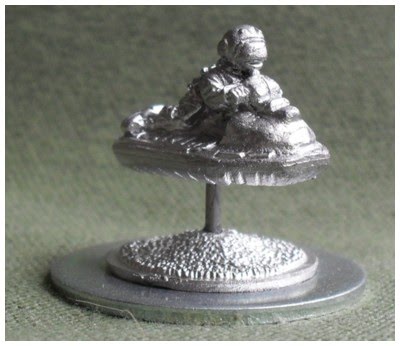
Hammer's Slammers Skimmer from Ground Zero GamesTrying to come back up to speed after the Field Guide project, and then a dose of the 'flu, with something to hand that didn't require much brain power. So, updated my modelling log with some average photos and heart-felt praise for figures by Splintered Light Miniatures and Ground Zero Games.

Monday, 21 February 2011

Field Manual

Field Manual CoverI had barely emailed off the last of the proofs for Field Manual - that proofing job that has basically eaten a month - when John at Spica had the book up on DrivethruRPG and, I believe, at LuLu.

There's an anouncement at the Spice Publishing site.

It's hard to review something I've been working very closely with (and I haven't seen the final product yet), but Bryan and Dan have laid out a rich background, sketched out an adventure scenario, and basically said, "Go for it". This is the type of scenario I like, and close to the way I run my own games - let the players loose, but know the landscape well enough that they can't catch you out or leave you flat-footed.

Well worth a look, if your players like more military styled games.

Thursday, 17 February 2011

Egad! Zhodani!

25mm Ventaurans by Denizen Miniatures

It's my birthday today, I'm four pages from the end of a massive edit job I've been doing for Spica Publishing, I have the day off and the weather is beautiful, and Tony from
Eureka Miniatures has just emailed me to see if I'm still interested in the 15mm versions of the Ventaurans that have been in the Eureka Miniatures' 300 Club since 2007!

It would appear that there has finally been sufficient interest, and sufficient people, that Eureka is looking at possibly getting Mike Broadbent to sculpt 15mm versions of the Denizen 25mm figures. Fantastic!

From what Tony says in his email, it would appear that the helmeted figures are a definate "go". I, personally, would like the helmetless figure as an officer as well. No word on the droids, so perhaps these are not the droids we are looking for.

If the Ventaurans look like the sort of armoured trooper you've been waiting for, I would suggest getting over to the Eureka site and pre-ordering some to help ensure they get into production.

Monday, 31 January 2011

Design Notes and Digressions

 'Breaking Orbit' - a piece of inspirational artwork I found when searching for the Australian band of the same nameI am not a big fan of empty drum blogging - the sort where the blogger commits himself to x number of posts in y time and then proceeds to burn bytes by telling his followers that he actually has nothing to post about.

My plans to continue with the history of my Traveller Universe, the RimWorlds, became slightly derailed this month when I took on a proof-reading job for Spica Publishing. The manuscript, while good, requires a lot more work than first anticipated and this has been eating most of my evenings. The end is, however, in sight - possibly much to the relief of John at Spica who had hoped to get the book out fairly soonish.

Once the book is done and dusted, I should be free to continue with the History of the RimWorlds, plus have another review to post. So, an empty drum post this time, but substance to come.

Thursday, 6 January 2011

Dilettante

Book 8: Dilettante - cover from Mongoose Publishing and used completely without permission
Mongoose Traveller Book 8: Dilettante

by Peter Nash

Want a character with access to great steaming piles of cash? Need a Patron who puts the “rich” back into “filthy rich”? Then, this character class expansion book from Mongoose could just be the thing for you.

As with previous expansion books, Dilettante adds seven career paths and 21 specialisations to the growing galaxy of Traveller Character Generation options:

· The Adventurer, through the specialisations of Explorer, Hunter and Archaeologist, is driven to be first-in, or to be first to shoot/tag a new creature, or to discover and explore ancient ruins.

· The Aristocrat - Courtier, Chevalier or Paramour - is one of the entourage of the Great and Good.

· The Celebrity specialises in either Actor, Musician, or Luminary – the latter being famous for being famous.

· The Competitor, be he/she Sportsman, Athlete or Gamer, strives for fame through the game –carrying the hopes and dreams of the masses with him (or her).

· The Connoisseur – Critic, Artisan or Collector values art in its myriad forms.

· The Dilettante can be a Wastrel, a Socialite, or a Philanthropist. Money is usually no object and the Dilettante spends it.

· The Humanitarian, whether an Idealist, a Raconteur or an Investigator, has the cash to bring the injustices of the Galaxy to light.

What I was struck with initially was how evocative these career pathway titles were for scenario ideas. While there is the temptation to run some sort of interstellar Jeeves and Wooster game with lots of Hooray Harrys, a closer look reveals quite a broad swathe of character possibilities. These can range from the “self-funded-Heinrich-Schliemann” type of gifted amateur archaeologist with fusion cutter in hand; to the high-profile sophonts’ rights activist; to the loyal retainer battling to protect the honour, status and good name of her noble employer; to the socialite who is always in the news feeds but of whom no-one can quite remember what exactly she is famous for.

In Dilettante, the author concentrates on the Social Status character stat, showing how it can be used as an indication of exactly how famous a famous person is – their reputation – and how far this recognition can extend. Ways that a character might increase their Social Status, either temporarily or permanently, are suggested, as well as the possibility that a character’s Status can mean different things at different times depending upon the social context.

Wealth – a dilettante needs it to maintain the lifestyle that he or she has become accustomed to. Deftly, the author has replaced the Cash benefit roll in the character generation section with a Portfolio roll. This has the effect of supercharging the mustering out cash benefits a character can receive. First, one discovers the nature of one’s Portfolio investment from each term – whether it consists of Business Investments, an Estate, a Pension, Property, a Stipend or Stocks - and then one rolls the value of that particular Portfolio Asset. Portfolio Assets range in value from Cr10,000 to MCr5.0 per roll. Social Standing Modifiers are added to the Value roll which, in theory, can push the cash value up to MCr50.0 per roll. From this Portfolio, the character receives a monthly income.

For those interested in the metagame, the character can adopt a more hands-on Portfolio Management style and attempt to accelerate their financial growth. This, of course, can all go horribly wrong.

There is a nice section that examines the pros and cons of Fame (high Social Status) and how the Dilettante can use high Status to their advantage, though this is balanced with a section of pitfalls that can trap or otherwise damage our socialite.

Along with the usual section on Equipment (which includes several starship deck plans), there is a look at ways of separating the unwary Dilettante from their wealth (or at least trimming it) through events and clubs.

Lastly, a chapter on campaigns looks at possible roles for Dilettantes, from patron to enemy to wild card, as well as possible Dilettante campaigns.

Dilettante, or at least the first printing, suffers from what can only be described as crap proofreading. I do not know if this is because deadline crunch forced the latest file to go to the printers before the proof-reader was finished, or whether the editor and proof-reader just aren’t up to the job, but to copy and paste the Book 6: Scoundrel cover tagline onto the cover of Book 8: Dilettante, and then miss-spell the book’s title on the contents page is pretty poor form. There are a number of spelling mistakes through the book that are just plain annoying. If Mongoose is still replacing faulty copies, as they should, then this shouldn’t be a problem – but it must be costing them so you’d think they’d sort this sort of thing out. I believe the typos were corrected for the second printing but I have not seen this.

But on the whole, Dilettante is a good work and could easily open up new and fertile fields for referees and players. If I were to buy a dead-tree version, I would check it out in the shop, first, but Pete Nash has done a fine and fascinating job in offering Players the chance to play high rollers, while offering Referees some mechanisms that help not to blow their campaigns apart with excess cash.

Friday, 31 December 2010

Alien Minor Race: The Johdari

A Johdari
During a couple of days holiday out at the beach at Maraetai, I finally had a chance to play around with “Flynn’s Guide to Alien Creation” that I reviewed back here.

It is a very quick and simple system to use, and I really enjoyed playing with it. I did find that having a vague idea of the alien race you wished to create enabled you to visualise the created alien more easily. Below is the second alien race I created – the Johdari – a member species of the Outrim Alliance and the race of the character Kephar Oanneshhu, the Engineer in the Webcomic “The BurrowWolf”.


The Johdari

Johdari are a humanoid Minor Race descended from nocturnal arboreal Omnivore/Hunter stock and are native to the planet Johunshhizair/Entorth A-886883-C.

Johdari are warm-blooded, have two genders and are egg-layers. Of Medium Build, though smaller and slighter than humans, they possess bilateral symmetary; have a pair of arms ending in two-fingered hands; and a pair of legs ending in two-prehensile toed feet, each with an apposable gripping spur. They are Fast, moving at 9m, Natural Climbers with Notable Dexterity (2d6+1), and posses a prehensile tail. Built for short, quick chases, they soon tire, having a Weak Endurance (2d6-1). Razor sharp teeth (Natural Weapon – Teeth) and Low Light Vision enabled primative Johdari to dominate the jungles of Johunshhizair, traits that their star-faring descendants still posses.

Maturing at Age 18, Johdari start aging around Age 38 (5 terms) and then slowly (DM+1 to aging rolls). All Johdari benefit from their government’s advanced education system and have Notable Education (2d6+1).

Skin colour ranges from dark brown to jet black and the skin is covered with a fine, downy, fur of a similar colour.